
Most people think the value of AI begins and ends with chatbots. That is the tip of the iceberg. For Africa, the real opportunity lies in deploying intelligent systems to tackle our most intractable problems, and in raising a generation of young people who know how to wield those systems with purpose.
While the world panics about AI taking jobs, I see the greatest leapfrogging opportunity this continent has ever had.
But there is a gap, and it is enormous. Over 10 million young Africans enter the labour market every single year, while the formal economy creates only about 3 million jobs to absorb them. That is a 7-million-person shortfall, every twelve months, compounding. Our education system was not designed for the agility this era demands. Meanwhile, millions of African businesses need to implement AI to survive and compete globally, and our young people are graduating into a world that is rewriting itself in real time, often unsure where they fit.
Closing that gap is the work. Our job is to equip young Africans with practical AI fluency, judgment, creative agency, cultural intelligence, and a problem-solving mindset to show up as strategic co-workers from day one. Not as passive outsourcers of their own thinking.
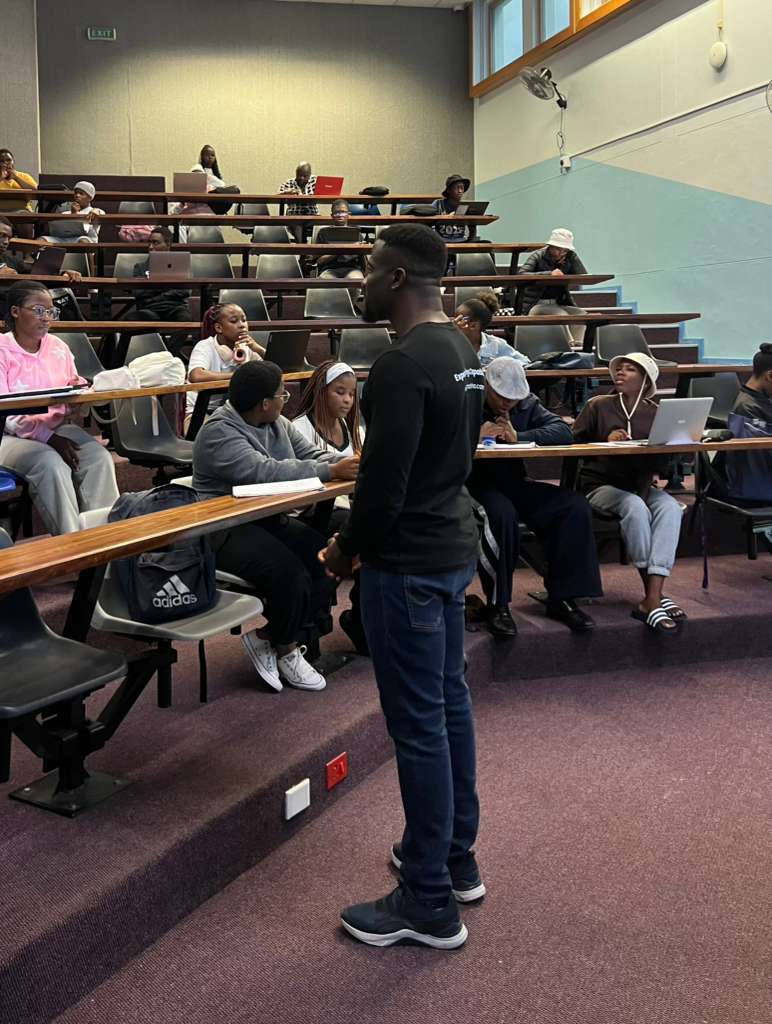
Yesterday, we brought that vision to life during the in-person sessions of the Mozisha AI Employability Lab at the University of the Western Cape, teaching the art of Creative Synthesis.
The Capitec Test
Here is the scenario I put to the students. You are applying for a graduate role at a bank like Capitec.
The average student asks AI to write a generic cover letter. It comes out polished, forgettable, and identical to the 1000 other applications that landed in the recruiter’s inbox that morning.
The Mozisha student does something different. Armed with the problem-solver mentality she has built through our programme, she does not start with the cover letter. She starts with research. She opens her AI tool and asks it to analyse Capitec’s last three annual reports. In minutes, she surfaces a pattern the average applicant would never spot: a persistent strategic struggle to onboard and retain Gen Z customers, repeatedly flagged in the bank’s own investor communications as a growth priority.
Now she has something no cover letter template can give her. Intelligence.
She synthesises that real corporate problem with a concept from pop culture she knows intimately, Spotify Wrapped. Then she prompts the AI to help her pitch a three-step app feature called “Capitec Wrapped”, a year-end financial recap that turns spending habits into shareable, gamified insights built natively for Gen Z users.
She then weaves this concept directly into her cover letter. Instead of the usual “I am a hardworking graduate with strong analytical skills,” her opening paragraph names the exact strategic challenge she has spotted in Capitec’s annual report, and offers a three-step feature concept to solve it. The rest of the letter uses her academic background and experience to show why she is the person to build it.
And most importantly, at the bottom of that cover letter, she drops a link to her Proof of Work portfolio. A living archive of projects she has been building since her second year at UWC. The recruiter clicks it, and there it is. The Capitec Wrapped concept as a mock feature brief, alongside other case studies, strategy decks, and prototypes she has built through the Mozisha programme. Not theory. Not promises. Evidence.
Two cover letters land on the same recruiter’s desk. One asks for a job. The other offers a solution and shows receipts. Only one gets read twice.
That is Creative Synthesis. Humans pick the two islands. AI builds the bridge.
What We Watched Unlock in the Room
During our live Mash-Up Sprint, we watched agency switch on in real time.
A Law student realised she could use AI to translate complex legal jargon into plain language. Within the hour, she was prototyping an AI-powered legal assistant to help informal businesses in Khayelitsha navigate compliance. Something that would genuinely serve spaza shop owners and township entrepreneurs who usually have no access to affordable legal advice.
The energy shifted so completely that other students started launching their own blogs right there in the room to begin marketing their new skills. Not “one day.” That afternoon.
This is the shift we are building for. Employment is one side of the coin. Entrepreneurship is the other. Over the next five years, Mozisha aims to raise over 100,000 African AI entrepreneurs, deploying viable solutions across agriculture, healthcare, green energy, and fintech. The sectors where Africa’s hardest problems live, and where its biggest opportunities are hiding in plain sight.
The Data
Watching these students leave the room relieved of their “AI anxiety” and excited to build was genuinely moving. And the data backed up the energy:
100% of students said they would recommend the sessions to a friend.
76% walked out confident they can use AI independently, right now.
The average career-value rating was 8.5 out of 10.
But my favourite data point was not a number. It was a line scrawled on a feedback form:
“My biggest aha: I don’t have to learn everything. I can use AI to help me.”
That sentence is the whole programme in one line.
At Mozisha, we are empowering young Africans, especially young women, to leverage AI superpowers while harnessing their own creativity, lived experience, and cultural fluency. Because the future of this continent will not be built by those who fear the technology, or by those who hand their thinking over to it. It will be built by those who learn to direct it with purpose.


6 Responses
Great article! Really insightful perspective. I found it very helpful and informative. cafrxnagmadhuxycxspcsgckmhtqbg
Great article! Really insightful perspective. I found it very helpful and informative. kanpggaihrnemmminncjtjeodecygq
This really resonated with me — your framing actually explains why my last attempt stalled. Looking forward to trying this out this week. [onzihxljxmhstgdgfs]
This site has a great selection of Jili games that actually pay out. I’ve spent a few hours here and the experience has been purely awesome. Check out phjili65.
[8528]Binggo login at registration | Legit slots via GCash,Gamitin ang binggo login app para sa mabilis na access. Mag-register account na para sa legit online slots gcash at download casino app android ngayon. visit: binggo
Very professional setup and the user experience is just spot on. Everything works exactly as it should. I suggest noblejililogin for a hassle-free time.