Many people think AI is simply faster, cheaper automation.
That assumption will quietly make many professionals and organizations irrelevant.
In the past, we experienced several “Great Automations”: the steam engine, the assembly line, and the personal computer. Each followed a familiar pattern. Machines replaced human muscle or repetitive calculation.
Artificial Intelligence is different.
It does not just execute tasks.
It reasons under uncertainty.
1. From Rules to Reasoning
Traditional automation is deterministic.
It follows rigid “If This Then That” logic.
When conditions deviate—even slightly—the system fails.
AI operates differently.
AI systems are probabilistic. They infer patterns rather than follow fixed rules. By learning from millions of examples, they handle unstructured data: interpreting medical images, summarizing complex documents, or detecting frustration in customer communication.
This is why AI moves into domains that once required human judgment.
It does not replace effort.
It replaces certainty.
2. The Productivity J-Curve Most Organizations Underestimate
Previous automation technologies were largely static. Once installed, productivity gains plateaued.
AI is dynamic.
Through reinforcement learning and agent-based workflows, AI systems improve over time—but not without friction.
MIT research describes a Productivity J-Curve.
Initial productivity often declines as organizations invest in training, workflow redesign, and coordination.
Gains compound only after these intangible investments mature.
While aggregate GDP growth sees modest annual effects (roughly 0.2%0.2% to 0.3%0.3%), task-level productivity tells a different story. Recent studies show human-AI teams achieve 50% to 60% gains in areas like software development and marketing.
The constraint is no longer tool capability.
It is organizational readiness.
3. The Human Premium Is Shifting
Historically, automation displaced physical labor.
AI is the first technology to systematically target high-skill cognitive work.
According to the World Economic Forum’s Future of Jobs Report 2025, by 2027 nearly a quarter of existing roles will change. While AI creates new jobs—such as AI specialists and sustainability roles—it places downward pressure on routine cognitive work like administrative support and data entry.
As AI commoditizes technical execution (basic coding, drafting, analysis), the market increasingly rewards something else:
- Judgment.
- Context.
- Empathy.
We are moving from a world where value came from knowing how to one where value comes from knowing what to ask and what to trust.
4. Why Organizations Are Flattening
Traditional firms rely on hierarchy to coordinate human labor.
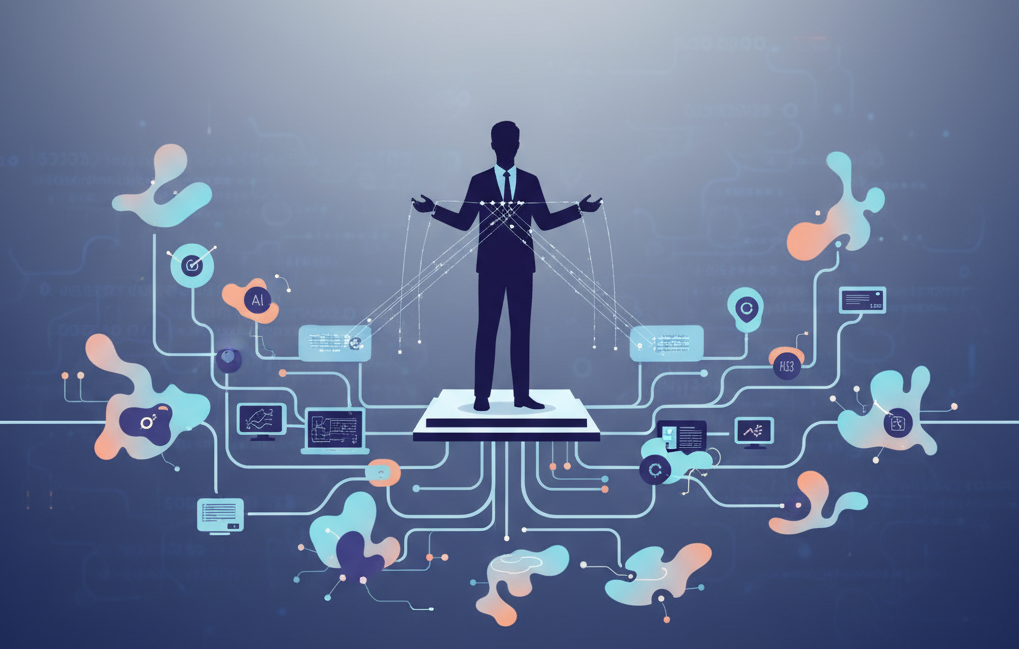
AI favors orchestration.
McKinsey’s State of AI 2025 survey shows 78% of organizations use AI in at least one function, and 21% have already restructured workflows around it.
This agentic shift allows fewer people to do more, sometimes eliminating entire layers of middle management oversight.
The competitive moat is also changing.
While large technology firms benefit from data scale, open-weight models like Llama-class systems have dramatically lowered the cost of high-level intelligence.
The new advantage is not owning intelligence.
It is the speed at which intelligence is integrated into work.
5. Societal Consequences We Cannot Ignore
AI’s impact is not only economic. It is social.
We are seeing increasing wage polarization, where top performers who leverage AI amplify their output, while mid-tier roles face displacement risk. This decoupling of productivity from hours worked fuels debates around UBI and robot taxation.
At the same time, AI introduces a new risk.
Unlike previous machines, AI generates truth-like misinformation at near-zero cost—destabilizing trust in information systems and forcing urgent conversations about digital identity and verification.
Conclusion: From Executors to Intent Architects
AI is not transformative because it works faster.
It is transformative because it changes who does the thinking.
In the 19th century, humans learned to manage machines.
In the 21st, we must learn to manage intelligence.
The future belongs to those who move beyond task execution and become Intent Architects—humans who define purpose, direction, and values, while machines handle the mechanics.

3 Responses
Heard isbetjogodeaposta is now available! If you want to try it out check out the link isbetjogodeaposta to learn more!
Okay, so I checked out boss778 and honestly, it’s got a decent selection. Nothing groundbreaking, but worth a look if you’re bored. Just remember to game responsibly, eh? Check it out here: boss778
Downloaded the 777sxgameapk and it’s… quirky. Some interesting games, though the interface could use some love. Proceed with caution and maybe an antivirus scan just in case. You can find it at: 777sxgameapk