The Demographic Illusion: Why Population Size Won’t Save Africa in the AI Era
For generations, classical development theory has treated population size as a central input to a nation’s economic expansion. The equation seemed practically guaranteed: a larger working-age population translates to a massive labor supply, larger domestic markets, and a demographic dividend that inevitably leads to national wealth.
For Africa, projected to be home to a quarter of the world’s population by 2050, this has been our promised superpower. But as we stand on the brink of the AI revolution, we have to ask a difficult question: Is the relationship between population size and economic output weakening?
The short answer is yes. And if we do not adjust our strategy, our demographic dividend could become a demographic illusion.
The Rise of General-Purpose AI
Recent progress in AI driven by large-scale machine learning systems from organizations like OpenAI, Google DeepMind, and Anthropic, has introduced a new dynamic. AI is no longer just a software tool; it functions as a general-purpose technology. It augments cognitive labor and, crucially, it can substitute for certain categories of human labor.
This weakens the historical advantage enjoyed by countries with large working-age populations. In the AI era, a small number of highly skilled people using advanced AI can produce as much, or more, output than a large population without access to it.
Look at Singapore: a nation of roughly 6 million people with a massive GDP per person, driven by a highly educated citizenry supported by advanced technology and strong institutions. Contrast this with nations boasting hundreds of millions of citizens but suffering from lower average productivity due to gaps in infrastructure, education, and tech access.
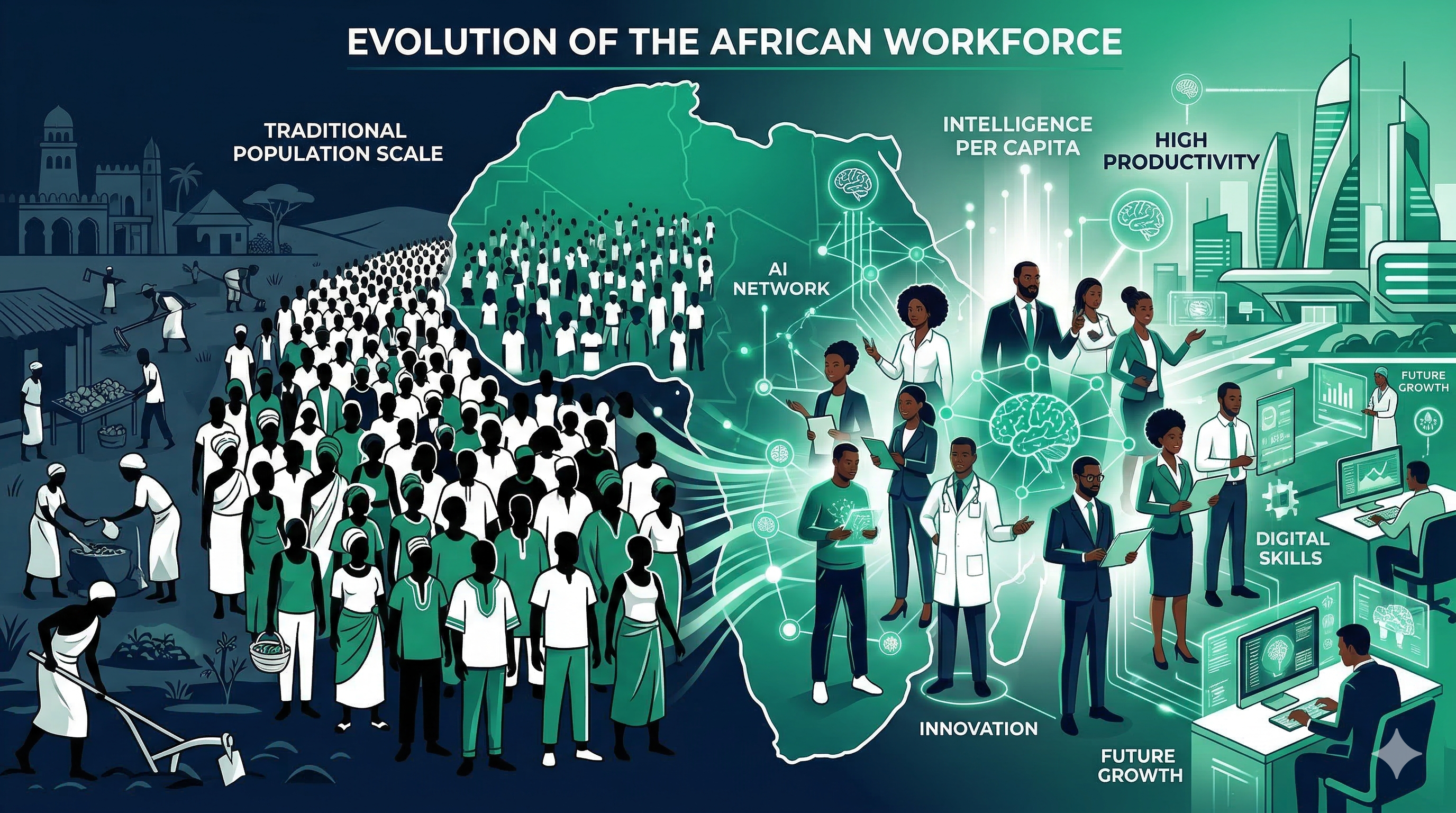
Raw human capital is no longer enough. We need to shift our focus to a new metric. I call it Intelligence Per Capita.
Intelligence Per Capita is the effective cognitive productivity per person. It is not a biological metric; it is an augmented economic output. It combines:
- Human intelligence and skill: Education, training, and problem-solving ability.
- Tools and technology available: The AI systems and infrastructure that amplify what humans can do.
To increase our Intelligence Per Capita, we must recognize the immediate threat to our current workforce pipeline: the first rung of the career ladder is disappearing.
The Disappearing First Rung and the “Experience Gap”
Across Africa and globally, the traditional entry-level role, the primary pathway through which young people acquire professional judgment and responsibility is rapidly eroding. As artificial intelligence automates routine execution tasks, employers increasingly expect graduates to arrive with experience they have had no opportunity to acquire.
We are diagnosing the problem incorrectly. This is not a skills gap or a credentials gap; it is an experience gap. Young people are excluded not because they lack education, but because they lack trusted exposure to real professional decision making.
Furthermore, if we simply throw AI tools at students without structure, we make the problem worse. Unstructured AI use in education is accelerating cognitive deskilling as learners shift from reasoning to prompting, and dependency replaces agency.
Moving from Operators to Orchestrators
If Africa is to thrive, we cannot rely solely on population scale. We must build a workforce capable of leveraging machine intelligence. We must ensure our youth exit our educational systems as system orchestrators and decision makers, not just task executors.
This is exactly why we built the Human-Led AI Learning and Employability Lab at Mozisha. We are creating the actionable infrastructure needed to compress the experience gap. Our model uses AI to speed up routine execution, but we intentionally protect and nurture human agency, judgment, and accountability. Population scale gave Africa its foundation, but Intelligence Per Capita will build our future. Next week, I’ll break down exactly how our Lab prevents the outsourcing of human thinking , fights cognitive de-skilling, and builds undeniable market value for our youth.

3 Responses
Need the ‘kết quả 7m ma cao’? I get all my results from this site. It’s my go-to place after every match. Such a great resource! kết quả 7m ma cao.
ss game is getting some buzz so I checked it out. Its okay, nothing ground breaking. If you are looking for ss game, check out the site yourself here: ss game
Okay, so I downloaded the okkingapp and I gotta say, it’s pretty slick. Easy to use, fast loading, and they seem to have all the games I’m interested in. Worth a look! okkingapp