
ITWeb Africa, citing the 2026 Economic Report on Data Centres in Africa published by the Africa Data Centres Association, reported that Africa accounts for just 0.6% of global data centre capacity. Active capacity on the continent stands at 360 MW against a global active capacity of 55,000 MW. Even if every announced African project materialises, the continent is projected to maintain rather than increase its global share as hyperscale expansion accelerates elsewhere. The Africa Data Centres Association chairperson, Faith Waithaka, put it plainly: “This is not a catch-up cycle. It is a race to avoid deeper structural marginalisation in global compute.”
She is right. And the race is real and urgent.
But I think we are missing something even more urgent.
Let me say what is clearly true first. Africa needs data centres. It needs compute infrastructure, cloud capacity, reliable connectivity, and the digital backbone that allows AI systems to run at scale. Governments and investors putting money into this are making the right bet. The continent cannot participate fully in the AI economy without it.
But I keep coming back to a story from 2007.
Kenya did not have a functioning nationwide banking infrastructure. The branch network that many countries had spent decades building was largely absent outside major cities. By the logic that says Africa cannot win in AI because it lacks compute, Kenya should never have become a global leader in mobile money. The infrastructure gap was simply too wide.
M-Pesa did not build more bank branches.
It made branches matter less.
Rather than waiting for traditional banking infrastructure to catch up, it built on a different kind of infrastructure that already existed: the mobile phone network in the hands of millions of Kenyans. Within a few years, Kenya had achieved levels of financial inclusion that many countries with mature banking systems could not match.
The compute gap will close. Not immediately, and not without sustained investment, but it will close. The data centres will come.
What concerns me more is a different kind of infrastructure.
One that does not appear in readiness rankings.
One that cannot be bought.
One that cannot be imported.
One that takes years to build.
The human layer.
There is a specific kind of person the AI economy is paying for right now. Not just someone who can use AI tools, though that matters. It is someone who can direct them.
Someone who can look at what an AI system produces and tell not only whether it sounds convincing, but whether it is right. Someone who brings judgment, contextual intelligence, creativity, and cultural understanding that no model trained thousands of kilometres away can replicate.
Someone who can sit across from a client in Lagos or a customer in Nairobi and understand what they actually need.
This is the person who makes the data centre worth building.
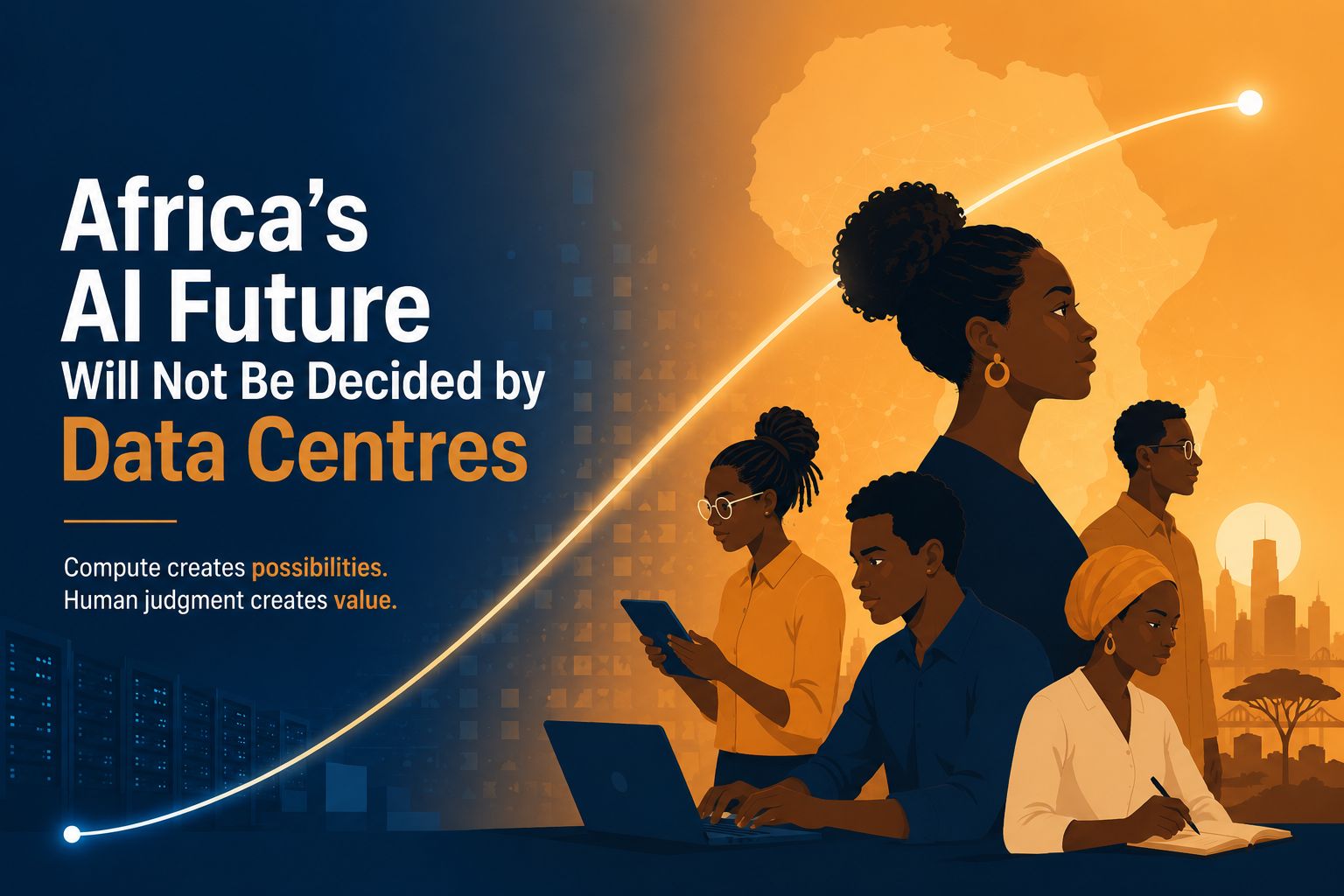
Compute generates possibilities.
Human judgment creates value.
You can have all the compute in the world and still produce nothing of lasting value if the people working alongside it cannot contribute more than the machine already can. Models generate outputs. Judgment determines which outputs matter.
In the AI economy, compute will increasingly become abundant.
Human judgment will remain scarce.
And scarce assets are where value accumulates.
Africa has a fraction of the global AI workforce despite having the world’s youngest population. The continent produces millions of graduates each year who are technically credentialed but often practically underprepared for the demands of an AI-driven economy.
The 2026 Global Outsourcing AI Readiness Index illustrates this challenge. South Africa ranked first in Africa for AI readiness, scoring 78 on population AI adoption and 65 on enterprise AI adoption. Yet its weakest score, just 53, was on the AI education pipeline.
Its weakest score was on the factor that matters most.
That is the number we should be talking about.
The conversation about compute dominates because infrastructure is visible. You can photograph a data centre. You can cut a ribbon. You can announce a billion-dollar investment.
The conversation about the human layer is different.
Developing judgment.
Building genuine AI fluency.
Teaching people to work alongside intelligent systems.
Helping them solve problems AI cannot solve on its own.
These things take years.
They rarely make headlines.
But they create something far more durable.
They create people capable of generating value that compute alone never will.
Africa’s leapfrog moment in mobile money happened because the infrastructure that mattered already existed. The people. The mobile phones. The willingness to use familiar technology in entirely new ways.
Africa’s next leapfrog moment in AI will follow a similar pattern.
It will not come simply from closing the compute gap.
It will come from investing in the infrastructure we already possess in abundance: our young people, their adaptability, their contextual intelligence, and the judgment that a generation raised solving complex problems with limited resources has developed almost by necessity.
Build the data centres.
Build the fibre.
Build the cloud.
Build the people who make those things matter.
Because Africa’s AI future will not ultimately be decided by the infrastructure we import.
It will be decided by the human capability we build.
And that is the infrastructure conversation we are still not having loudly enough.


2 Responses
The mobile experience is just top notch. I can play my favorite games anywhere thanks to 7a777app.
Solid platform with great security. I feel safe depositing here and the gaming options are simply endless. Check it out! pk888starz