
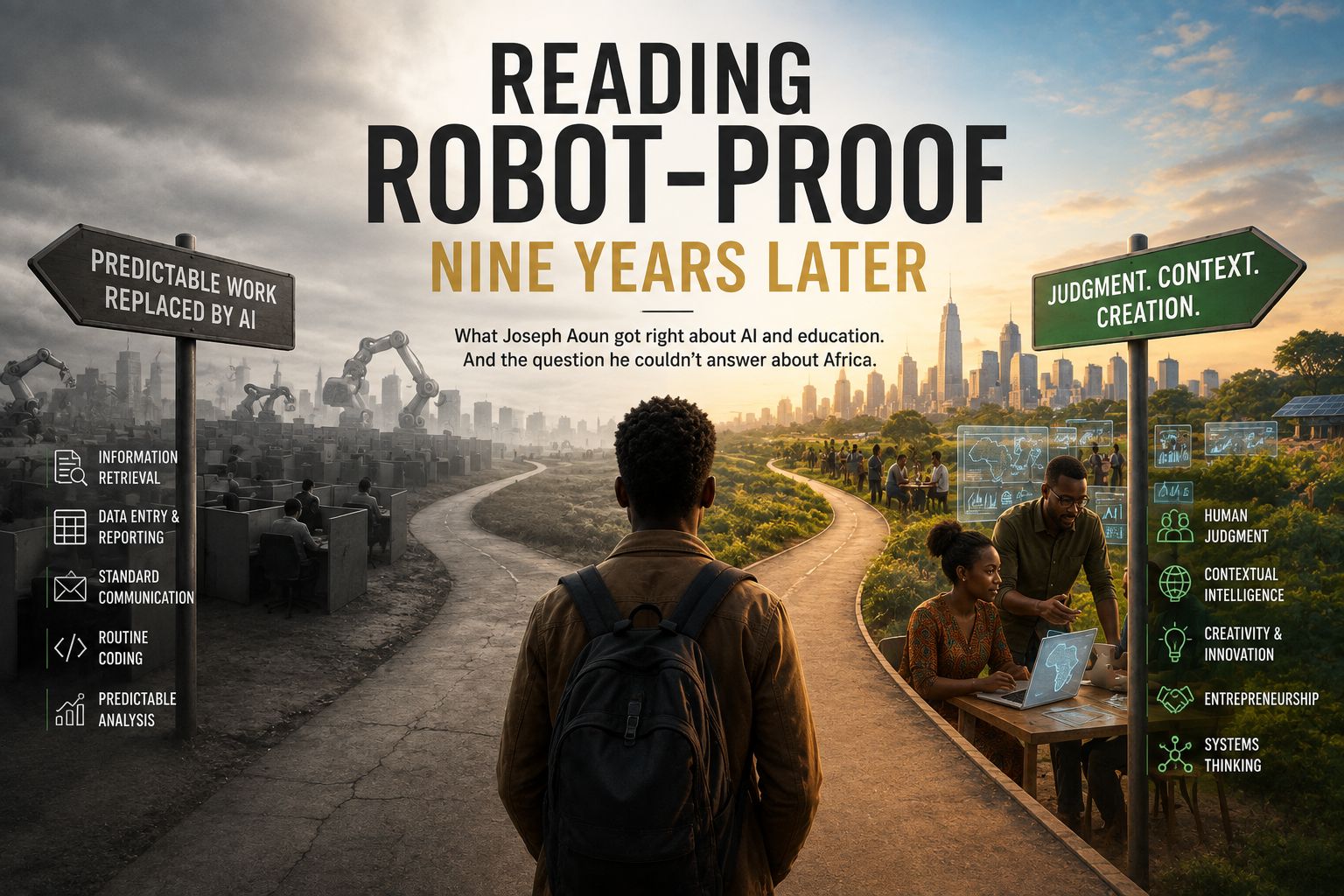
I recently read Joseph Aoun’s Robot-Proof: Higher Education in the Age of Artificial Intelligence, published in 2017 by the president of Northeastern University. Nine years is a long time in the AI world, long enough that reading it now feels less like reading a book and more like grading a prediction.
What he saw coming
In 2017, Aoun was already worried about something most people were not yet worried about. He cites a 2015 McKinsey report finding that 45 percent of the work Americans are paid to do could be automated using existing technology, and other estimates suggesting software would replace between a third and a half of all finance jobs within a decade. He was writing at a moment when IBM’s Watson was still the most famous AI system in the world, a machine that helped oncologists read clinical trial data and was about to try its hand at improving teaching in New York City public schools.
Reading this now, after watching AI absorb legal research, financial analysis, and much of the writing and coding that once defined entry-level knowledge work, Aoun’s concern does not read as alarmist. It reads as early. He was pointing at the right mountain years before most of higher education could see it on the horizon.
His response was to propose a framework he calls humanics, and it is worth describing properly because most summaries of this book flatten it into three literacies and stop there. It is actually built in two parts.
The first part is content. Three new literacies that sit alongside the traditional foundations of reading, writing, and arithmetic. Data literacy, the ability to read, analyse, and use information at scale. Technological literacy, a working understanding of how machines and software actually function. Human literacy, the humanities, communication, and design skills that allow people to thrive in a human world rather than only a digital one.
The second part is less discussed but, I think, more interesting. Four cognitive capacities that sit on top of the literacies. Systems thinking, the ability to see how the parts of something connect. Entrepreneurship, applying a creative mindset to economic and social problems. Cultural agility, the ability to operate across different, even conflicting, cultural contexts. And critical thinking, the old liberal arts staple of disciplined and rational judgment.
“Instead of training laborers, a robot-proof education trains creators,” he writes. That is the whole argument in one sentence, and I think it has aged remarkably well.
Where the book was writing from
This book was written entirely from inside one of the best-resourced universities in the United States, for an audience thinking about the United States. Northeastern’s co-op model, its employer partnerships, and its academic planning all assume an institution with the capital and infrastructure to redesign itself.
The word Africa does not appear once in the entire book. Not in the introduction, not in the chapter on what employers want, and not in the afterword. The phrase “developing world” appears exactly once, in passing.
I do not say this as a criticism of Aoun’s thinking, which is careful and genuinely prescient. I say it because it reveals the limits of even the best work on this subject. Aoun was answering the question: given an institution with resources, how should it redesign itself for a world where machines do more of the specified work?
He was not answering, and had no obligation to answer, the question I have been circling in my own writing this year. What happens to the millions of young people whose universities do not have Northeastern’s resources, and are unlikely to have them within the timeframe this transition actually demands?
One part of his framework surprised me by how closely it aligns with an argument I have been developing over the past year. Cultural agility, the third of his four cognitive capacities, comes remarkably close to what I have been calling contextual intelligence. Both recognise that success depends on understanding the environment in which decisions are made. But I think contextual intelligence goes a step further. It is not only about navigating different cultures. It is about understanding the economic, institutional, and infrastructural realities that determine whether an AI-generated solution will actually work in a specific place.
A Lagos market trader whose financial records do not fit a Western credit model. A supply chain designed for stable electricity operating in a market where power outages are routine. A healthcare workflow copied from Europe into a clinic with entirely different constraints. The challenge is not simply cultural. It is contextual.
Aoun identifies the instinct, even if he does not develop it in this direction. He saw that human understanding would become more valuable, not less, as machines became more capable. I did not expect to find that in a book written from Boston, and I respect that he did.
Testing the prediction against reality
The real value of reading this book nine years later is that you get to compare the 2017 predictions with what actually happened.
Aoun predicted that predictable work, including high-skill knowledge work, would increasingly come within reach of machines. That happened, and arguably faster than even his most urgent chapters suggested.
He predicted that the old model of front-loaded education, four years of university followed by decades of applying what you learned, would begin to break down. Lifelong learning would become a structural requirement rather than a nice idea. That has also happened, although perhaps not through the mechanism he expected. Much of today’s retraining is taking place outside universities through employers, online platforms, and specialised training organisations rather than through universities extending their reach into people’s working lives.
He predicted that creation, rather than information retrieval, would become the central skill worth developing. That closely parallels an argument I have been making across my own recent essays. As AI absorbs more of the specified work, judgment and contextual intelligence become increasingly scarce and valuable. Reading Aoun after arriving at a similar conclusion from a completely different starting point, an African talent company rather than an American university, was a clarifying experience. Two people, thinking from very different vantage points, arriving at remarkably similar conclusions almost a decade apart.
Not every aspect of the future unfolded exactly as expected. The speed of change was driven less by universities than by frontier AI companies. Large language models placed capabilities into the hands of hundreds of millions of people almost overnight, compressing adoption timelines from years into months. Even so, that shift reinforces rather than weakens Aoun’s central argument. As access to intelligence becomes abundant, the distinctly human capacities become even more valuable.
Where I think the book falls short, reading it now, is not in what it says but in what it assumes. It assumes the institution doing the redesign already has the resources to redesign. For most of the world, that assumption does not hold, and will not hold for a long time.
The humanics framework describes the right destination. It says very little about how a university with no co-op budget, no employer partnership office, and no dedicated academic planning department gets there.
What I take from this
Aoun’s central bet held up. Machines did come for much of the specified work, and creators, not laborers, are increasingly what the emerging economy rewards. His humanics framework, especially the underappreciated four cognitive capacities sitting quietly behind the three literacies everyone quotes, remains one of the more serious attempts to describe what a post-automation education should actually contain.
What the book does not do is answer the question from the vantage point of a continent it never mentions. That is the work I have been trying to do in my own writing this year. Not because Aoun got anything wrong, but because he was answering a different question.
Robot-Proof describes an important destination. The question that still occupies me is how the rest of the world, especially Africa, reaches that destination without Northeastern’s resources, timeline, or institutional machinery. The map is valuable. The roads still need to be built.


6 Responses
This site has quickly become my go to for weekend gaming sessions. The registration process was simple and I got my account verified in no time. I really like the community chat feature and the transparent rules on all promotions. krkrclud
The interface is super clean and I can find my favorite slots in just a few clicks. Game selection keeps getting refreshed so it never gets boring. I appreciate how they process every request quickly and keep the platform running without any annoying downtime. A solid choice for daily entertainment. playiwin
Downloaded this app last night and it completely changed how I enjoy my free time. No bugs no weird crashes and the slots just keep spinning perfectly. If you want a hassle free mobile experience you should really try this out. Click here apkrr777
Found this through a friend and I am glad I did. It is a very welcoming community and the site is incredibly stable. Cheers to sahabat11login for the great experience.
Best platform for local players. The registration was easy and I started playing within minutes. Definitely visit 168jllogin.
Just downloaded the app and I am already impressed. Everything loads fast and the games are addictive. Highly recommend jiligemsapk to everyone.