
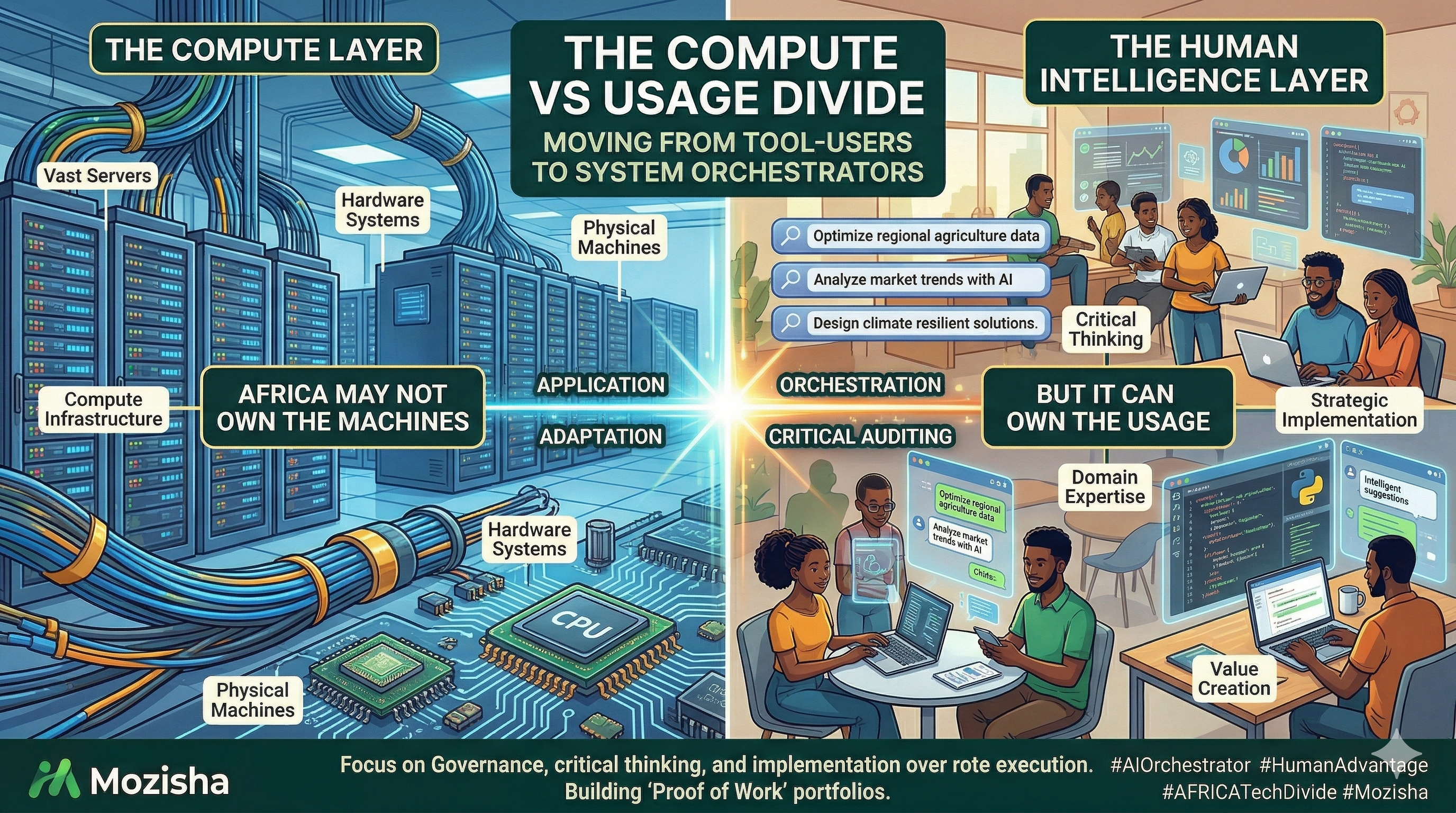
When global policymakers and tech leaders discuss Artificial Intelligence, the conversation almost always defaults to hardware. The headlines are dominated by a multibillion dollar race for microchips, supercomputers, and massive data centers.
According to the 2025 AI Index from the Stanford Institute for Human Centered AI, the United States leads the world in private AI investment by pouring over $109.1 billion into the sector in 2024, far exceeding China’s $9.3 billion.
We call this the Machine Layer. Because of this heavy focus on hardware, traditional global indexes often rank African nations near the bottom in AI Readiness. We do not have the localized server density, and we cannot ignore the reality of the global compute divide.
Does this mean Africa should abandon the infrastructure race? Absolutely not. We must secure our own compute capabilities to ensure digital sovereignty and build indigenous models. But here is the hard truth of the 2030 digital economy: Infrastructure alone does not determine who wins the AI economy. We need a stake in the compute layer, but we must completely commit to our greatest area of competitive advantage, which is the Human Intelligence Layer.
The False Assumption: Where Economic Value Actually Sits
There is a massive blind spot in the current AI narrative. We assume that the countries building the foundation models will be the only ones extracting the economic value.
But if we look at the AI value chain, a different reality emerges. We are entering the AI Orchestration Economy, where the highest leverage lies not in creating the tools, but in directing them.
AI Layer | Who Dominates Currently | Economic Value |
Chips & Hardware | US / Taiwan | High |
Cloud Infrastructure | US / China | High |
Foundation Models | US / China | High |
Applications | Global | Medium |
AI Usage / Orchestration | Anyone (The Next Frontier) | Very High |
The Compute vs. Usage Divide
Having the world’s most advanced compute infrastructure does not guarantee workforce adoption.
Look at the latest global diffusion data. Despite its dominance in research and development, the United States ranks 24th globally in actual workforce AI adoption at just 28.3%. The true economic winners of this immediate era are countries like the UAE at 64% adoption and Singapore at 61%. They realized early on that your immediate economic return on investment comes from having a workforce that expertly adopts and orchestrates these global tools.
This is the Compute vs. Usage Divide. And it is exactly where Africa can leapfrog.
Africa’s Grassroots AI Explosion
While the Global North boasts an average workforce AI adoption rate of nearly 25% compared to the Global South at around 14%, a closer look at Africa reveals a massive grassroots revolution.
It is crucial to acknowledge our digital divide, as millions of Africans still lack basic internet access. However, if we look specifically at the digitally connected workforce, informal usage is exploding. Recent data shows that among Nigerian adults with internet access, up to 88% have used AI chatbots, with a staggering 91% of those users applying them to work tasks. In Kenya, formal business adoption has reached 35%, and in South Africa, general employee use is soaring past 70%.
Many see our broader infrastructure gaps as a deficit. But when paired with our demographics, the sheer velocity of adoption among our connected youth is actually Africa’s greatest strategic advantage.
According to the World Bank, roughly 15 million young people enter the Sub Saharan African labor market every single year. The Global North possesses the compute power, but we possess the human power. AI can generate a thousand generic business strategies in seconds, but the true bottleneck of the future economy is the human judgment required to govern that AI, reject its hallucinations, and adapt its output to local and real world contexts.
What Africa Must Do to Win the Orchestration Economy
To transform our demographic dividend into a global AI execution engine, we need a holistic strategy aligned with frameworks like the African Union’s Digital Transformation Strategy:
- Secure Sovereign Compute and Local Context: We need local data centers to fine tune open source models on African realities. AI must speak our languages and understand local regulations like South Africa’s POPIA.
- Mobile First Accessibility: The majority of our youth experience AI on a smartphone, not a desktop. We need targeted policy interventions to lower broadband costs and encourage mobile native AI applications.
- Agile Policy and Governance: Governments must build data protection frameworks that foster trust without stifling grassroots innovation.
- Overhaul Digital Skilling: The massive percentage of African youth currently using AI are often doing so informally by simply copying and pasting from chatbots. This leads directly to cognitive de-skilling. We must shift our educational focus from rote task execution to critical AI orchestration.
The Mozisha Case Study: Operationalizing the Human Layer
At Mozisha, we recognize that while Africa builds its physical infrastructure, we cannot afford to wait. The high grassroots usage in places like Nigeria and South Africa proves the demand is there, but that raw usage must be structured. We must aggressively deploy our human advantage today.
Through the Mozisha AI Learning and Employability Lab, we are intercepting students before they fall into the deskilling trap. We teach them the Judgment Loop, a framework that forces users to treat AI as a baseline rather than a crutch. Using tools like the Mozisha Taste Engine, we train young Africans to audit AI outputs, inject local context, and produce auditable Reasoning Logs.
We are not just teaching software skills; we are building a Judgment Economy. We are helping students build Proof of Work portfolios that make them indispensable to global employers.
Africa must absolutely lay its own digital bricks and secure its compute. But if we want to dominate the next decade, we must completely commit to what we already have in abundance. By aggressively structuring and developing the Human Intelligence Layer, we can turn millions of young people into the world’s premier AI Orchestrators.


8 Responses
GPT Image 2 Prompts helps creators find ready-to-use prompt ideas for portraits, product shots, posters, branding, and cinematic scenes at ChatGPT Images Prompts. Pick a prompt, adjust the details, and move from a blank page to a stronger image brief.
Tam olarak geçen salı bu konuyu düşünüyordum, aceleyle tasarımları yetiştirmeye çalışırken fark ettim ki işimi inanılmaz kolaylaştırıyorlar. [ssnhzkebjoivckeumm]
I have been searching for a reliable platform for a while and finally found it. The mobile app runs smoothly on my phone and the withdrawal process took less than an hour. Really happy with the customer support team as well. vngamble
Finding a casino site that actually works smoothly on my device was a headache until I found this one. The game selection is fantastic and I never have to wait long for my payouts. Everything runs so smoothly that I forget I am playing on a mobile screen. Great experience all around. casinoggbet
Feeling lucky today and this app is the perfect place to test my streak. The graphics are top notch. Visit pkluckygameapk now.
I was skeptical at first but this platform is legit. The customer service is very helpful and the withdrawal process is quick. Give krmmwin a try if you want a reliable site.
[5658]58win | Link vào chính thức và cách chơi nổ hũ chi tiết,58win cung cấp link vào chính thức, hướng dẫn tải app nhanh chóng và cách nạp tiền qua momo tiện lợi. Trải nghiệm sảnh casino đẳng cấp, đăng ký ngay hôm nay! visit: 58win
I just downloaded the app and the experience is super smooth. The interface is very intuitive and the games load quickly. Definitely a great choice for anyone looking for a reliable platform. Check out inspin777apk for more details!