
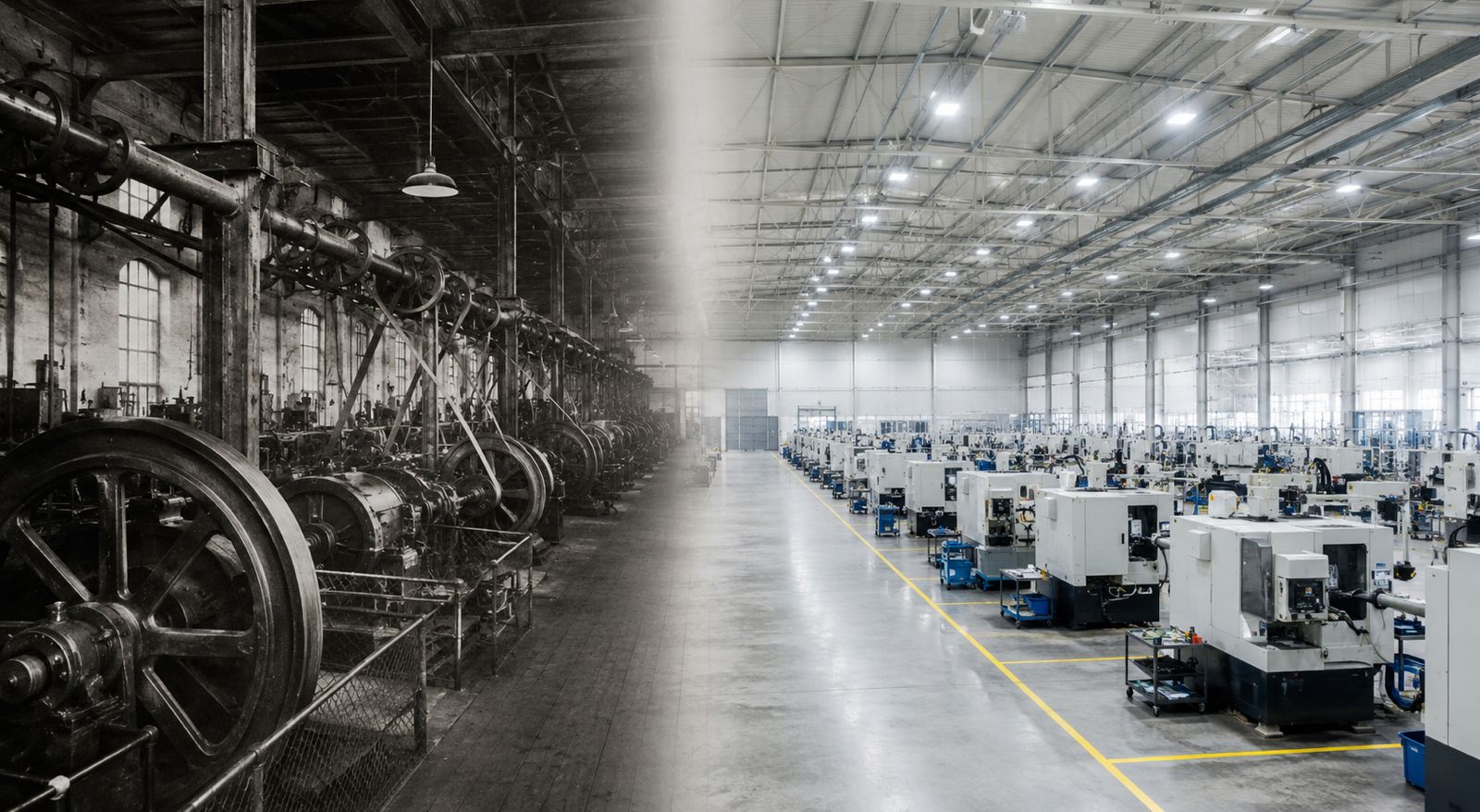
The Flat Factory
In 1882, Thomas Edison switched on the Pearl Street generating station in lower Manhattan, and from that moment the technology to run a modern factory on electricity existed. Everything the American twentieth century would eventually build itself on, the assembly line, the mass-market automobile, the industrial economy that followed, was, technically, already possible.
It did not happen for roughly forty years. By 1899, according to the economic historian Paul David’s widely cited account of the period, less than five percent of factory machinery in the United States ran on electric motors. Contemporaries joked that dynamos were everywhere except in the productivity statistics. The delay had nothing to do with whether the technology worked. It worked. The delay was a question of architecture, and understanding why takes a moment inside the world these factory owners actually lived in.
Nineteenth-century factories were built around the steam engine, a single, enormous power source whose energy had to be distributed across the entire building through a network of overhead shafts, pulleys, and leather belts. Coal only made economic sense burned at scale, so factories grew vertical, floor stacked on floor, and every machine on every floor was positioned as close as possible to the shaft feeding it. The height of the building, the placement of each machine, the whole logic of the floor plan, existed to solve one problem: minimise the distance power had to travel from the centre.
So when the dynamo arrived, the owners of these factories did the obvious thing available to them. They pulled out the steam engine and installed an electric one in exactly the same place. The building stayed. The shafts stayed. The belts stayed. The vertical stack of floors, each one still organised around proximity to a central power source, stayed. The gain from this swap was real, but it was incremental. They had changed the engine and kept the entire architecture the engine had originally dictated.
The transformation that actually mattered came later, and it came from a different kind of insight altogether. Someone realised that electric motors, unlike steam engines, did not need to be large or centralised to work efficiently. A motor small enough to sit on a single machine could power that machine directly. And if every machine had its own motor, the shaft distributing power from a central point became unnecessary. If the shaft was unnecessary, so was a building designed around minimising distance to one. Factories could be built flat instead, spread out horizontally across open ground, organised not around where power had to travel from but around how the actual work flowed from one stage to the next.
Ford built his new factory in Michigan rather than in one of the established industrial centres, and it is reasonable to read that choice as connected to exactly this shift, since the flat, horizontal design this new architecture demanded needed a kind of open ground the older, denser industrial cities simply did not have to offer. The productivity gain this version of electrification produced was not incremental. It was, in large part, the gain that powered the American twentieth century.
Why the incumbents could not follow
None of this happened because the owners of the old vertical factories were blind to what electricity made possible. Many of them understood it perfectly well. What they could not do was act on it, because each of them had already sunk enormous capital into a multi-storey building, a boiler system, a shaft and belt network, and expensive urban land close to the centre of an established industrial city. Rebuilding flat meant walking away from all of it and starting again from nothing, and very few people running a profitable operation were willing to bet the entire company on that kind of rebuild.
The shift toward flat, unit-drive factories that eventually took hold through the 1920s was not, in reality, a single clean story of new entrants building fresh while every incumbent simply failed to adapt. It was messier and more gradual than that, spread unevenly across industries and years. But the underlying pattern holds regardless of how tidy the historical record is: new capital, unencumbered by decades of sunk investment in the old design, faced a dramatically lower barrier to adopting the new architecture than capital that was already committed to defending what it had built.
The same pattern repeated, decades later, with computing. Companies that already owned a mainframe tended to adopt personal computers by connecting them to the mainframe as terminals, an improvement, but an incremental one wearing the costume of transformation. The companies that actually built the modern computing economy, and the internet economy that grew on top of it, were largely new entrants who had never owned a mainframe and therefore had nothing standing in the way of building around the new technology’s own logic from the start.
What was actually changing, underneath the machinery
It would be easy to read this as a story about factory layout and stop there, but the more useful reading goes one level deeper, into what the shaft and the org chart above it were both actually solving for.
In 1937, the economist Ronald Coase asked a deceptively simple question: if markets can coordinate economic activity on their own, why do firms exist at all? His answer was that markets are not free to use. Finding suppliers, negotiating terms, monitoring performance, enforcing agreements, all of it carries a cost, what economists call a transaction cost. A firm exists, in Coase’s account, because it is often cheaper to coordinate certain activities inside an organisation than to buy them piece by piece on the open market. Firms grow for exactly this reason, expanding until the cost of managing one more activity internally exceeds the cost of simply going to the market for it.
Coase was explaining why firms exist and how large they grow. He was not writing about what happens to a firm’s shape once the cost of coordinating internally changes. But his framework is the right lens for what electricity, and now AI, actually do to an organisation. Hierarchies exist, in large part, because internal coordination used to be expensive. A company needed a chief executive, then a layer of vice presidents, then directors, then managers, then supervisors, then the people actually doing the work, because information travelled slowly, execution was costly, and much of what each layer did was monitor and translate for the layer beneath it. The steam-powered factory’s shaft was, in a sense, a physical version of the same logic running through the organisation chart sitting above it: one source of authority, its output routed downward through fixed channels, everyone’s position in the structure defined largely by their distance from the centre.
Electricity, once factories actually redesigned themselves around it rather than merely swapping the engine, lowered the cost of distributing power to the point where centralisation stopped being necessary at all. I think AI is doing something structurally similar to the cost of internal coordination itself, the exact variable Coase identified as the reason firms take the shape and size they do. A capable person, working with AI as genuine leverage rather than as a convenience, can now research, draft, analyse, model, and execute work that used to require an entire department passing tasks down a chain of approval and back up again. If internal coordination costs fall the way Coase’s framework suggests they are falling, the boundary and shape of the firm should be expected to shift with them. The basic unit of production is moving, quietly but unmistakably, from the department to the individually capable operator.
This is a meaningfully different claim from simply saying AI makes companies smaller. A flat organisation is not necessarily a tiny one. What actually matters is not headcount but how much any single person is able to own and execute directly, rather than how many layers exist above and below them purely to check and re-check their work.
Where this leaves African companies, and institutions, specifically
It is worth being precise here rather than sweeping, because the temptation to say “Africa” as a single structural category is strong and mostly wrong. The continent holds banks with genuinely deep legacy systems, telecom operators sitting on decades of sunk infrastructure, government bureaucracies as entrenched as any in the world, and multinational subsidiaries running organisational structures imported wholesale from wherever their parent company happens to be headquartered. None of those occupy the flat position in this story.
What the continent has, in unusually large supply, is organisational whitespace: companies and institutions young enough, or informal enough, that they have not yet accumulated the layers AI is now on the verge of making unnecessary. That is a more precise claim than saying Africa has no legacy architecture at all, and a more defensible one. The advantage belongs to the specific firms and institutions carrying the least inherited hierarchy, and those firms happen to be disproportionately concentrated on this continent right now, not to the continent as a whole by default.
M-Pesa remains the clearest illustration of this logic, properly understood. Kenya in 2007 already had an established banking sector, with real branches and real accounts and real customers. M-Pesa did not succeed because banking infrastructure was simply absent. It succeeded because it never needed to reproduce the full architecture of traditional banking in order to build a mass-market payments system that actually worked for people the existing banks were not reaching well. It built a new transaction layer that bypassed the old one entirely, rather than trying to out-compete it on its own terms. That, I think, is the precise shape of the AI opportunity in front of African companies today: not the total absence of an incumbent structure to worry about, but the freedom to solve the underlying problem without first having to reconstruct the old solution’s scaffolding.
The whole argument compresses, if you want it in its simplest form, into a single four-part mapping. The steam factory ran on a central engine distributing power through shafts to fixed machines. The old corporation ran on central management distributing decisions through departments to fixed roles. The electric factory ran on distributed motors, each machine independent, its layout redesigned around the flow of work. The AI-native company runs on distributed intelligence, each operator equipped and independent, its structure redesigned around outcomes rather than approval chains.
There is a genuine paradox sitting inside this that deserves to be named rather than smoothed over. Africa holds a small fraction of global data centre capacity, a real infrastructure disadvantage that will take years of sustained investment to close. At the same time, the continent’s relative absence of legacy organisational architecture is a real advantage in the race that will ultimately decide who captures the most value from AI. Both things are true at once, without contradicting each other: behind in the infrastructure race, and ahead in the organisational one.
The early evidence for this is already visible in how the fastest-growing companies are choosing to staff themselves. Research published by Ramp Economics Lab and Revelio Labs in 2026, tracking headcount and AI spending across more than 21,000 companies, found that firms making the largest, most sustained investments in AI grew headcount 10.2 percent over the following two years, with entry-level headcount growing 12 percent, while companies treating AI as a bolt-on addition to their existing structure saw no meaningful change either way. The distinction the researchers drew was never simply whether a company used AI. It was whether the company had actually rebuilt itself around it.
A lean African team scaling operations across dozens of markets with only a handful of people is not making do with a resource constraint dressed up as a virtue. Structurally, it is the unit-drive factory: distributed intelligence sitting at the point of the work, each operator given real ownership over an outcome rather than a narrow task, with no chain of departments standing between a decision and the person actually capable of making it well.
The founders who will win this
The founder who wins the next decade will not be the one who bolts an AI assistant onto an organisation chart copied wholesale from a company built in 1985. That founder is still running the incremental version of this story, no matter how impressive the tool itself might be.
The founder who wins is building around a different unit entirely: capable operators carrying real ownership, equipped with AI as genuine leverage rather than decoration, the whole structure organised around how value is actually created rather than around a management hierarchy inherited from an economy that priced coordination very differently. That company could not have been built as easily inside the old structures, in much the same way Ford could not have built his factory on cramped, expensive land inside an established industrial city. It can be built, instead, by whoever is carrying the least old architecture to defend.
Edison’s dynamo sat idle in the productivity statistics for forty years because the people best positioned to use it were also the people most trapped by everything they had already built.
The people who will build the next economy are the ones with nothing to protect.
Companies and institutions carrying the least legacy architecture to defend are unusually concentrated on this continent right now.


6 Responses
Finally found a version that doesn’t lag. The installation was a breeze and everything works perfectly on my phone. Highly recommend inyono777download if you want a stable app.
The customer support is super responsive and helped me set up my account in no time. Really happy with the service at idkaviar88.
Switched to this casino recently and I am blown away by how smooth everything runs. Fast payments, fair terms, and a huge selection of slots and table games. I especially appreciate the 24/7 chat feature because help is just a tap away. Will definitely keep coming back. bd7j777casino
[2509]1xbet বাংলাদেশ লগইন ও অ্যাপ ডাউনলোড | বিকাশ ক্যাসিনো গেম,1xbet বাংলাদেশ লগইন করে উপভোগ করুন লাইভ ডিলার ক্যাসিনো সাইট এবং অনলাইন স্লট গেম ট্রিকস। বিকাশ দিয়ে ক্যাসিনো গেম খেলতে আজই অ্যাপটি ডাউনলোড করুন। visit: 1xbet
Really impressed with the bonuses here. It is hard to find a place that actually delivers on its promises these days, but brwim4444 does it right. Definitely giving it five stars.
Super impressed with the game variety here. Everything loads quickly and the customer support is actually helpful. Highly recommend vnop88 to anyone who loves online gaming.